Monday, 19 September 2016

Romanticism - a brief description

There are several characteristics involved in Romanticism,  including: sympathetic interest in the past, sensibility, love and nature, mysticism, romantic criticism and primitism.  Romanticism first came about as a reaction to rationalism and the best work was made in the early 18th century. It wasn't until after the horrific occurrences of the French Revolution,  that Artists decided to express their emotions through their paintings.
one Artist's work which I found interesting was the work of J W M Turner (1775-1851), a well-known landscape Artist who expressed his feelings through his paintings. One painting which caught my attention was, Snow storm: Hannibal and his army crossing the Alps. This painting describes the long,  tiring fight Hannibals soldiers had trying to cross the Alps in 218Bc against the foul forces of nature. Turner uses a large black storm cloud to emphasise the darkness and difficulty felt. The people are shadowed by the storm cloud, although there is sunlight trying to break through the clouds,  there doesn't seem to be much hope.
Snowstorm :Hannibal and his army crossing the Alps (1812)

Another Artist who was inspired by nature was, Caspar David Friedrich(1774-1840) .  Although,  both Artists shared their inspiration,  they worked completely different to one another.  Fredrich used fine brush strokes to express his emotion in, Arctic Shipwreck (1824). This painting is about the harshness of forces of nature and not being in control.
Arctic Shipwreck (1824)

Another Artist that I looked at was famous poet, printmaker and painter,  William Blake (1757-1827). I found his work,  Frontispiece to the Visions of the Daughters of Aibon (1793) were interesting,  and slightly disturbing. The painting contains Oothoon tied back to back with her rapist (Bromion) while her lover (Theotormon) holds his head in despair and jealousy. The painting is about Blakes views of Judeo-christian values of marriage. 
This was created near the end of the 18th century but shows a completely different style from Turner and Fredrich.

Frontispiece to the Visions of the Daughters of Aibon (1793)

After looking at various Artist who played a large part in the Romanticism movement,  I still feel I have alot to discover about the emotional attatchment these Artists felt and what made them feel so passionate that they felt the need to express their feelings.

Friday, 16 September 2016

Mono print - self portrait

In class we are doing a unit on self portraits. As a starting point,  we experimented with mono printing, using black ink on a board with paper on top. We began with 5 a4  printed images of our head and shoulders,  one face on, one image looking each side and two 3/4 facing images.  I was very nervous about this unit initially as my weakness is drawing portraits, to my releif,  the task was alot easier than I thought.
 We began by placing one of the printed images on top of a piece of paper, (on top of the rolled ink), then drew around the image. We were free to choose what we wanted to draw with, and how to add shading and detail through various mark making.  This was simple and fun to do.
I began with a linear drawing,  then adding more shading and heavier lines to the next. I followed that by alternating which image I was using as a template and began to experiment.  I came up with some interesting results by using multiple images,  thinking about composition and placement.  I was enthusiastic about how far I took take my idea's and I was very pleased with my results.  Throughout the process, I also learned how to add tones and that by using various pressure,  I could produce a more realistic final image.


Wednesday, 14 September 2016

Artist Presentation - Mary Morrison

Mary Morrison is an Artist based in the Scottish Borders,  currently based at the wasp Artist Studios in Selkirk.  She is originally from the Isle of Harris,  which is the largest Island in the Outer Hebrides.
All the work she produces is done using Oil paint, sometimes just oil, other times she uses mixed media, such as oil and ash, silver leaf, turpentine or  pencil as well as other mediums. She also uses maps, poems and quotes from books when creating a collage. She likes to work on a flat surface, preferably the floor so that she has more space to move her art. Morrison also describes her work as, not fully abstract but uses the landscape as the main part of her work.
Throughout her work, Morrison has been influenced by many people. One person was Agnes Martin,  an American abstract painter, who used meditative geometry throughout her work and provided a sense of gentle and quiet in each piece.
In 2007 she started cutting out section's of Gaelic song books and sticking them to her work. As music was also a large influence,  she also used sections of songs within some of her work as well.
      Cosmos- oil, mixed media on canvas

Within this artwork,  is a circular stave with dropped paint on it to represent music notes.
Morrison explained that she used alot of silver pigment throughout her work and that she wants her paintings to create a sense of mystery,  rather than being too obvious. Below are another two examples of her work influenced by music.
   Sea Music - Undertow oil, shellac,                pigment on canvas
                      Wave - oil on canvas

Another inspiration came from the work of John Schueler, an American Painter who painted large canvases of the quick transition in weather and used landscape within his work.
Mark Rothko, an American landscape Artist,  Shirazeh Houshiary, an Iranian Artist who provided a sense of geometry and spiritual within her work. And Anish Kapoor, a British Artist and Sculptor were also an inspiration to Morrison.
"Tide tables"  is a series of paintings which include measurements of the sea. Some paintings in this series include, "morning tide 2" and "high blue day on Scalpay 1"
morning tide 2- oil and mixed media on canvas.
High blue day on Scalpay 1 - oil, collage on paper
The image above includes poetry by a Scottish Poet, where she created the feeling of the Poem which was based on Scalpay, ( the place she grew up).
Throughout the next series of work, Morrison used sections of maps within her work."Out West" was based on a story that her sister had written and contains a map reference in the corner. The maps within her work are used to represent where she grew up so there is a personal connection within each piece.
When Morrison was asked to take part in an exhibition,  entitled Utopia, she was very pleased and created works entitled, "Utopia 1", "Utopia 2" and "Navigation - Utopia"
Another exhibition which she participated in was, "Fonn", this was held in Stornoway,  in the Scottish Highlands.  The work presented included "sea heart"
    Sea heart - oil, mixed media on paper

Other paintings presented at this time were,  "Shadow Maps". This was a series of paintings using darker colours such as greys and blacks rather than the vibrant blues which was mostly used.
Black shore- oil. Mixed media on board 

After her work being seen at Stornoway,  Morrison was invited to another exhibition,  "Bard Mhealboist Project"
At this stage, Morrison made work inspired by the Poem of Murdoch Macfarlane aswell as focusing on connecting with the landscape in a subtle and symbolic way.
A few other paintings which Morrison included in her presentation were 
Road - Croft Markings,  Scalpay,  oil on card

Utopia 1 - oil mixed media on board 

Compass - oil, mixed media on canvas
Luskentyre - oil, Ash, pigment on paper

Overall,  Morrison provided a very informative presentation.  I quite enjoyed her style of work as well. Maps, graphs and tide lines are not really an interest of mine, but I liked the fact that her work was relevant to her childhood and location where she grew up. I thought the use of oil was interesting having been mixed with a variety of media. It provided a light,  soft feeling, whereas my understanding of oil paint is that, it is usually quite dense and heavy. I definitely related to the use of vibrant colours and  really enjoyed the unique wavy patterns within each piece.  There is an exhibition being held on the 1St and 2nd of October next month, at the Wasp studios in Selkirk.  I am very keen to view these artworks in person. I would like to admire the work close up to gain a real sense of the harmonious tones and movement used throughout.

Artist Presentation - Mary Morrison

Mary Morrison is an Artist based in the Scottish Borders,  currently based at the wasp Artist Studios in Selkirk.  She is originally from the Isle of Harris,  which is the largest Island in the Outer Hebrides.
All the work she produces is done using Oil paint, sometimes just oil, other times she uses mixed media, such as oil and ash, silver leaf, turpentine or  pencil as well as other mediums. She also uses maps, poems and quotes from books when creating a collage. She likes to work on a flat surface, preferably the floor so that she has more space to move her art. Morrison also describes her work as, not fully abstract but uses the landscape as the main part of her work.
Throughout her work, Morrison has been influenced by many people. One person was Agnes Martin,  an American abstract painter, who used meditative geometry throughout her work and provided a sense of gentle and quiet in each piece.
In 2007 she started cutting out section's of Gaelic song books and sticking them to her work. As music was also a large influence,  she also used sections of songs within some of her work as well.
      Cosmos- oil, mixed media on canvas
Within this artwork,  is a circular stave with dropped paint on it to represent music notes.
Morrison explained that she used alot of silver pigment throughout her work and that she wants her paintings to create a sense of mystery,  rather than being too obvious. Below are another two examples of her work influenced by music.
   Sea Music - Undertow oil, shellac,                pigment on canvas
                      Wave - oil on canvas

Another inspiration came from the work of John Schueler, an American Painter who painted large canvases of the quick transition in weather and used landscape within his work.
Mark Rothko, an American landscape Artist,  Shirazeh Houshiary, an Iranian Artist who provided a sense of geometry and spiritual within her work. And Anish Kapoor, a British Artist and Sculptor were also an inspiration to Morrison.
"Tide tables"  is a series of paintings which include measurements of the sea. Some paintings in this series include, "morning tide 2" and "high blue day on Scalpay 1"
morning tide 2- oil and mixed media on canvas.
High blue day on Scalpay 1 - oil, collage on paper
The image above includes poetry by a Scottish Poet, where she created the feeling of the Poem which was based on Scalpay, ( the place she grew up).
Throughout the next series of work, Morrison used sections of maps within her work."Out West" was based on a story that her sister had written and contains a map reference in the corner. The maps within her work are used to represent where she grew up so there is a personal connection within each piece.
When Morrison was asked to take part in an exhibition,  entitled Utopia, she was very pleased and created works entitled, "Utopia 1", "Utopia 2" and "Navigation - Utopia"
Another exhibition which she participated in was, "Fonn", this was held in Stornoway,  in the Scottish Highlands.  The work presented included "sea heart"
    Sea heart - oil, mixed media on paper

Another paintings presented at this time were,  "Shadow Maps". This was a series of paintings using darker colours such as greys and blacks rather than the vibrant blues which was mostly used.
Black shore- oil. Mixed media on board 

After her work being seen at Stornoway,  Morrison was invited to another exhibition,  "Bard Mhealboist Project"
At this stage, Morrison made work inspired by the Poem of Murdoch Macfarlane aswell as focusing on connecting with the landscape in a subtle and symbolic way.
A few other paintings which Morrison included in her presentation were 
Road - Croft Markings,  Scalpay,  oil on card

Utopia 1 - oil mixed media on board 

Compass - oil, mixed media on canvas
Luskentyre - oil, Ash, pigment on paper

Overall,  Morrison provided a very informative presentation.  I quite enjoyed her style of work as well. Maps, graphs and tide lines are not really an interest of mine, but I liked the fact that her work was relevant to her childhood and location where she grew up. I thought the use of oil was interesting having been mixed with a variety of media. It provided a light,  soft feeling, whereas my understanding of oil paint is that, it is usually quite dense and heavy. I definitely related to the use of vibrant colours and  really enjoyed the unique wavy patterns within each piece.  There is an exhibition being held on the 1St and 2nd of October next month, at the Wasp studios in Selkirk.  I am very keen to view these artworks in person. I would like to admire the work close up to gain a real sense of the harmonious tones and movement used throughout.

Tuesday, 13 September 2016

Hawick Glass Blowing


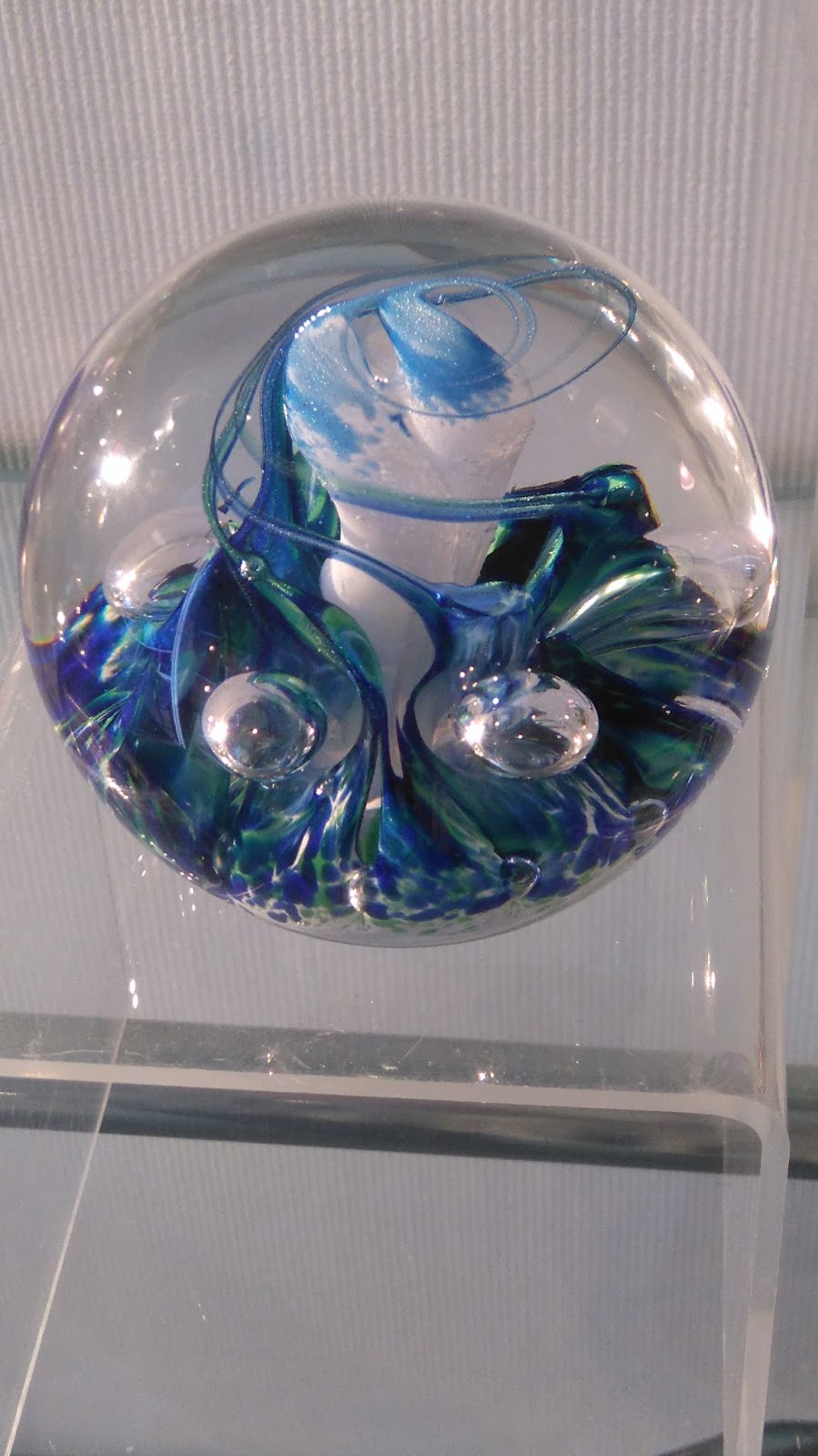
Yesterday I went to visit the glass blowing place in Hawick,  it is situated just behind Homebase on the outskirts of the town.  The business is run by father and son and has been for many years.
As I approached the place, I was greeted with a warm, friendly welcome.  The workplace is open to the public to view and ask questions while the items are being made. This was a new experience for me but I was absolutely amazed and the techniques used to create such gorgeous ornaments. I found out that the main furnace takes up to a week to heat up to the ideal temperature to melt the glass mix (which looks like small stones).  The working temperature of the furnace is approximately 1115-c, while the melting temperature can reach 1260-c. After the glass is melted,  it is then put in another heated oven so that it can be manipulated into various shapes. A large variety of coloured glass crystals are used within this process to add colour and shapes to each item. There are also a variety of tools used for cooling,  shaping,  adding patterns and cutting.  The heat that you can feel from the furnace is incredibly hot and it glows orange. After each item is made, it is left in a kiln overnight to set.
There is also a small shop attached to the workplace where they sell a variety of items including :ornaments such as birds, sheep, hearts,  and vases, lighting,  hanging decorations,  candle holders and paperweights, they also produced awards for various companies. They also informed me that they can also make items to order with colours chosen by the customer, i thought this was a nice touch so that each item can be made to suit the customers needs.
I would definitely recommend anyone to go and see this amazing art form.